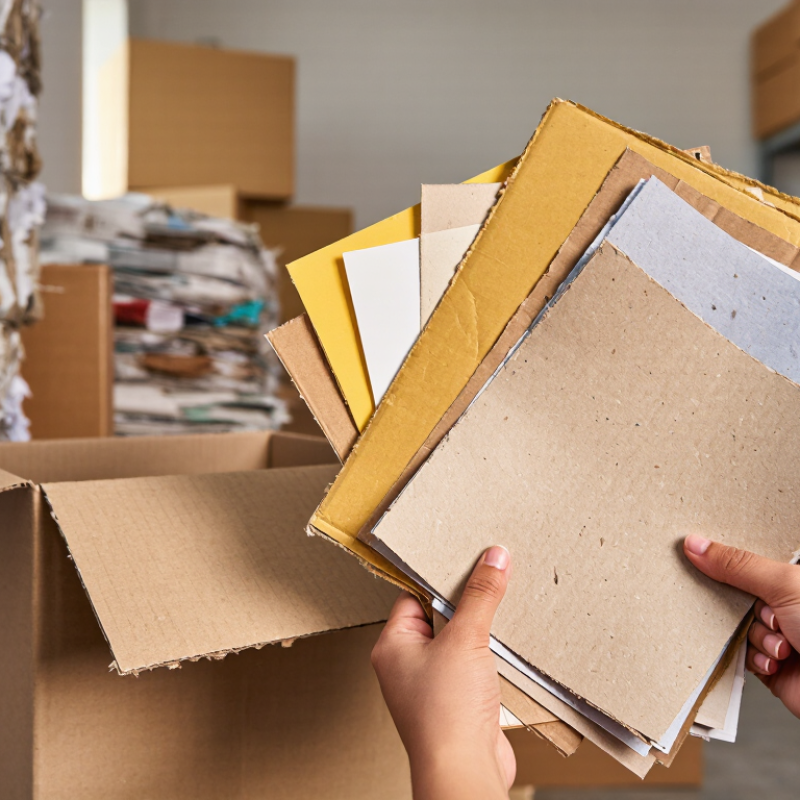
| Recycled paper |
Paper made partly or entirely from recovered paper fibers instead of only newly harvested wood fibers. |
May contain post-consumer fiber, pre-consumer fiber, or a combination of both. Appearance, strength, and brightness vary by grade and processing method. |
Printing, writing, packaging, tissue, stationery, and specialty papers. |
“Recycled” does not necessarily mean 100% recycled content; the actual percentage should be checked on the product specification. |
| Post-consumer recycled paper |
Made from paper products that have been used by consumers, collected, sorted, and processed for reuse. |
Diverts used paper from disposal and generally requires sorting and contaminant removal before pulping. |
Office paper, notebooks, envelopes, brochures, cartons, and paper towels. |
Fiber quality can vary because the recovered material may include inks, coatings, adhesives, and mixed paper grades. |
| Pre-consumer recycled paper |
Made from paper waste recovered during manufacturing or conversion before the product reaches the consumer. |
Often has a more predictable composition because the material comes from controlled production streams. |
Printing grades, packaging board, tissue, and industrial paper products. |
It is recovered material, but it has not necessarily been used by a consumer. |
| Deinked recycled paper |
Paper made from recovered fibers that have undergone deinking to remove much of the ink before new paper is produced. |
Can provide a cleaner, lighter appearance, although brightness depends on the furnish and bleaching or brightening process. |
Office papers, books, magazines, newspapers, and printing papers. |
Deinking does not remove every substance; coatings, fillers, and adhesive residues may affect the final paper. |
| Unbleached recycled paper |
Recycled paper produced without, or with limited use of, bleaching intended to increase whiteness. |
Usually beige, gray, or brownish in appearance; often retains a more natural visual texture. |
Wrapping paper, bags, cartons, craft paper, and protective packaging. |
Color consistency and print contrast may differ from those of bright white paper. |
| Recycled printing and writing paper |
A paper grade formulated for writing, copying, laser printing, inkjet printing, or general office use. |
Surface smoothness, opacity, brightness, basis weight, and runnability are selected for print performance. |
Printer paper, copier paper, forms, letterheads, notebooks, and brochures. |
The suitable grade depends on the printer, ink or toner, required image quality, and sheet weight. |
| Recycled packaging paper and board |
Recovered-fiber paper or paperboard designed for bags, cartons, boxes, wraps, and protective packaging. |
Emphasizes stiffness, compression strength, tear resistance, or cushioning rather than a highly smooth surface. |
Shipping boxes, folding cartons, paper bags, sleeves, and inserts. |
Moisture, grease, food-contact, and barrier requirements may require additional coatings or treatments. |
| Recycled tissue paper |
Soft, lightweight paper made with recovered fibers for absorbent or sanitary products. |
Designed for softness, absorbency, bulk, and adequate wet or dry strength; recycled content may affect texture and color. |
Paper towels, napkins, toilet tissue, facial tissue, and protective wrapping. |
Performance requirements and applicable hygiene or regulatory standards should be verified for the intended use. |
| Fiber content |
The proportion of recycled fibers and newly produced fibers in the sheet. |
Products may be labeled with a specific recycled-content percentage, such as 30%, 50%, or 100%, when supported by product information. |
Used to compare environmental attributes and select paper for a particular performance requirement. |
A higher recycled-content percentage does not alone indicate a particular level of strength, whiteness, or print quality. |
| Brightness and appearance |
The visual whiteness, shade, uniformity, and surface look of the paper. |
May range from bright white to natural gray, beige, or brown. Deinking and optical brightening can influence appearance. |
Important for office documents, commercial printing, packaging, and design projects. |
Brightness is a visual property and should not be treated as a direct measure of recycled content. |
| Recyclability |
The practical ability of a paper product to be collected, sorted, repulped, and made into another paper product. |
Paper is generally recyclable, but recyclability can be reduced by plastic films, metallic layers, heavy coatings, food contamination, and mixed materials. |
Used for evaluating packaging, labels, printed products, and end-of-life disposal options. |
Actual acceptance depends on local collection, sorting, and recycling facilities. |
 Jingkuo